The Patrolling Playbook
Patrolling is not just movement — it’s controlled, disciplined maneuver through terrain to achieve a purpose. Recon, combat, or security, every patrol succeeds or fails based on the control measures, discipline, and sequencing that frame it from step-off to exfiltration.
Staging the Patrol
Every patrol begins in the Patrol Base or Staging Area. This is where weapons are checked, ammo topped off, radios confirmed, and accountability is locked in. Patrol orders are issued, priorities of work completed, and routes rehearsed. Leaders designate:
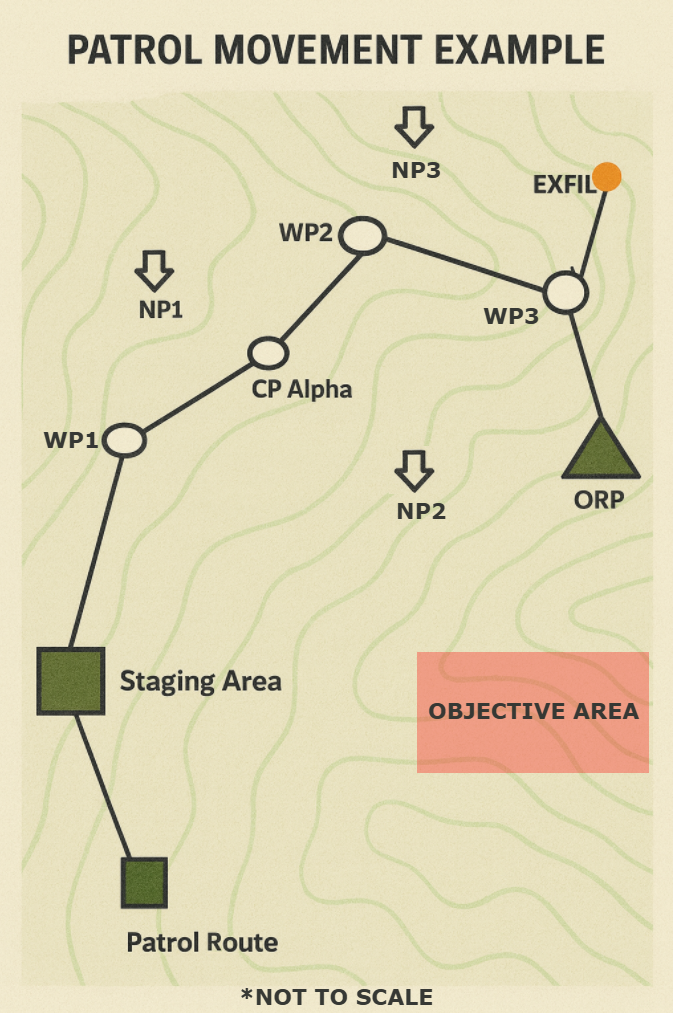
- Waypoints (WPs): intermediate reference points to maintain orientation.
- Navigation Points (NAVPOINTs): terrain-based navigation aids (ridge lines, road bends, rivers).
- Checkpoints (CPs): reporting locations tied to terrain, used to track movement and progress.
- Objective Rally Point (ORP): final covered and concealed holding area before a reconnaissance task or combat action.
The patrol is set here — not when it hits the first bound.
Departure and Initial Movement
Upon departure, the patrol establishes a Near-Side Rally Point just outside the base. This becomes the first fallback if compromised early. Movement is then conducted in assigned formation — file, staggered file, or wedge — with security sectors clearly defined.
- CPs and WPs mark the route. Each CP is tied to a terrain feature and acknowledged over comms when passed.
- NAVPOINTs are mental or mapped references to aid leaders in dead reckoning, azimuth checks, and pacing.
- At each WP, the patrol leader confirms orientation, checks spacing, and ensures no stragglers.
Movement Control Measures
As the patrol pushes deeper, discipline dictates survival:
- Checkpoints (CPs): ensure accountability and allow for quick SITREPs to higher. Example: “CP2 passed, time 2130, no enemy activity.”
- Rally Points (RPs): designated fallback positions. Every danger area (road, linear obstacle, open terrain) has both near-side and far-side rally points to regroup if split under fire.
- Waypoints (WPs): serve as mental breaks and coordination halts — often planned at terrain features like bends, bridges, or clearings.
- NAVPOINTs: unique terrain identifiers used for azimuth and pace count checks. Example: “NAVPOINT 3 is the hilltop with the lone tree at grid 124567.”
These measures keep the patrol oriented and under control, no matter the conditions.
The Objective Rally Point (ORP)
For recon or combat patrols, the ORP is established several hundred meters short of the target. It is:
- Covered and concealed.
- Defensible for 360° security.
- Used for redistribution, last comms checks, and leader’s recon.
At the ORP, the leader confirms the route forward, identifies final assault or observation positions, and briefs fallback options. The ORP is the last major pause before execution of the task.
On Patrol Tasks
- Reconnaissance Patrols: use ORPs to launch short recon teams forward. WPs and CPs are critical for route discipline and reporting findings back. The task is to observe, not fight.
- Combat Patrols: ORPs serve as the jump-off for raids or ambushes. CPs and WPs along the exfil route allow for rapid movement under control.
- Security Patrols: WPs and CPs define sectors of responsibility. The patrol roves between NAVPOINTs to ensure coverage.
Actions on Contact
Contact can happen at CPs, along routes, or near objectives. Rally Points dictate regroup measures:
- Break Contact: fall back to the last established RP.
- Fix and Flank: if combat patrol, use WPs or NAVPOINTs to maneuver.
- Recon Patrols: disengage immediately and fall back to ORP.
Battle drills are rehearsed, but discipline in control measures prevents chaos.
Exfiltration and Return
The return route mirrors the infiltration route, using reverse CPs, WPs, and NAVPOINTs for control. Leaders call SITREPs at each CP, and the patrol collapses rally points in reverse order.
Once back at the Patrol Base or Staging Area:
- ACE reports (Ammo, Casualties, Equipment) are given.
- SSE or recon findings are reported via SALUTE.
- Final AAR is conducted to capture lessons learned.
Patrol Movement Example
Key Points to Emphasize
- Staging sets the patrol. CPs, WPs, NAVPOINTs, and RPs are defined before step-off.
- Rally Points are life insurance — never move without them.
- Checkpoints = reporting and accountability. WPs = navigation and control.
- ORPs = final control measure before task execution.
- NAVPOINTs guide navigation and prevent disorientation.
- Exfil uses the same discipline as infil — reverse control measures.
⚔️ Endstate: The patrol departs organized, navigates through WPs and CPs with discipline, orients on NAVPOINTs, uses ORPs as staging for tasks, maintains constant security, accomplishes its reconnaissance/combat/security mission, and returns intact with mission results.